Statistics explained
Powerball Number Pairs: Counting Co-Occurrences Correctly
By MyBallWin · Reviewed · 2 min read
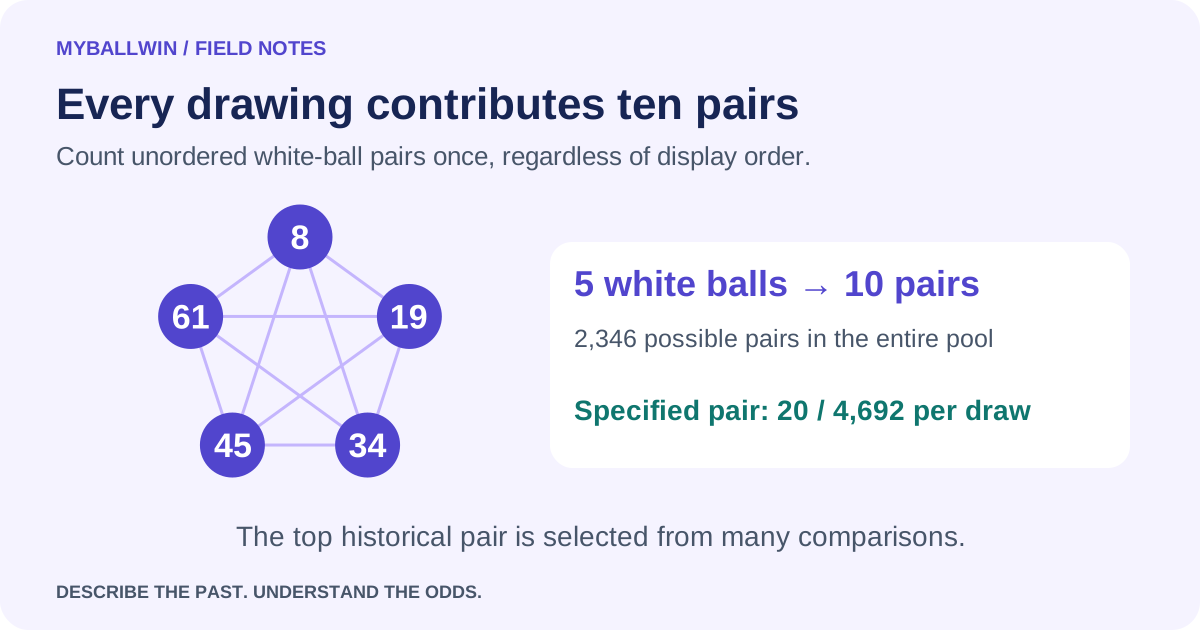
A pair frequency counts drawings containing both specified white balls. Each five-ball drawing contributes ten unordered pairs. There are 2,346 possible pairs in the 1–69 pool, so a top-ranked historical pair must be interpreted in the context of many comparisons.
Build pairs without double counting
Start with five distinct white balls, sort them, and form every two-number subset. The illustrative set 8, 19, 34, 45, 61 produces ten pairs, including 8–19 and 45–61. Treat 8–19 and 19–8 as the same pair. Storing the smaller value first gives each pair a consistent identifier and prevents accidental duplication.
A pair count is not the sum of the individual numbers' frequencies. If 8 appears ten times and 19 appears twelve times, they may still never have appeared together. Co-occurrence asks about the intersection of two events. Keep white/red combinations in a separately named analysis because they have different selection probabilities and do not belong in the same ranking.
Use the correct baseline
There are C(69,2) = 2,346 eligible white-ball pairs. The probability that one specified pair appears in a drawing is (5/69) × (4/68) = 20/4,692, about 0.426%. Equivalently, choose the other three white balls from the remaining 67 values and divide by all five-ball combinations: C(67,3)/C(69,5).
Across 100 independent draws, a specified pair therefore has an expected count of about 0.426. Many pairs will be absent, while a few will appear multiple times. Inspecting all 2,346 pairs makes an unusually high maximum more likely than inspecting only one preselected pair. The winner of that retrospective ranking is not automatically evidence of a special relationship.
Make pair analysis reproducible
Record the date window, draw count, pool definition, and tie-breaking rule. Include zero-count pairs if the goal is to describe the complete distribution. If you publish only the leading pairs, label the table as a selected subset and avoid implying that omitted pairs are impossible. Each verified draw should increase the total pair counts by exactly ten.
Pairs can be useful for checking a counting program or exploring combinations, but they do not supply a proven selection advantage. Any hypothesis discovered after inspecting a ranking needs evaluation on separate data with the test defined in advance. Even then, apparent differences require careful uncertainty analysis. For everyday archive use, the honest conclusion is simply how often a pair co-occurred in the stated records.
Official sources
Game rules and archive references checked October 3, 2026. Calculations and examples are MyBallWin explanations based on the stated assumptions.