Statistics explained
Are Consecutive Powerball Numbers Unusual?
By MyBallWin · Reviewed · 2 min read
Consecutive numbers are ordinary possible outcomes. A particular adjacent pair is uncommon in one draw, but there are many possible adjacent pairs. The chance of at least one consecutive pair among five white balls is 1 − C(65,5)/C(69,5), about 26.5%.
Define an adjacent pair
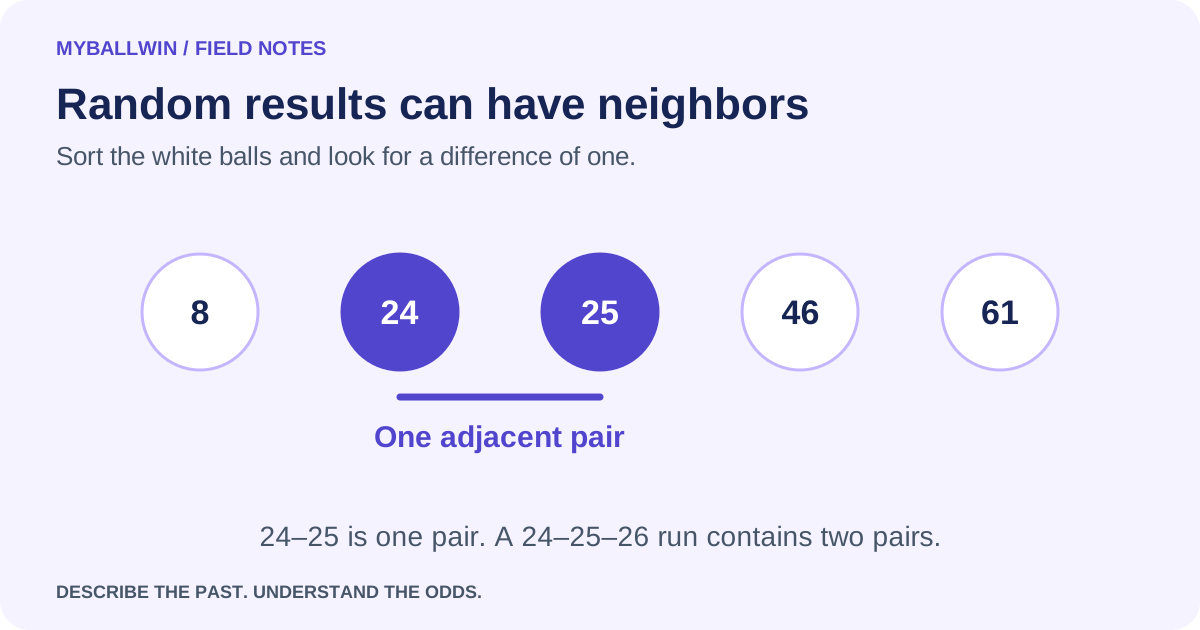
Sort the five white balls in ascending order, then subtract each number from its neighbor. A difference of one marks an adjacent pair. The illustrative set 8, 24, 25, 46, 61 contains one pair: 24 and 25. A set containing 24, 25, and 26 contains two adjacent pairs, although those pairs belong to one three-number run.
Keep runs and pair counts distinct. A chart that counts drawings with any adjacency gives each drawing at most one count. A chart that counts all adjacent pairs can give a drawing several counts. Neither should mix in the red ball, whose number comes from a separate pool and is not part of the sorted white-ball sequence.
Why the overall event is not rare
There are C(69,5) possible five-white-ball sets. The number without adjacent values is C(65,5). One way to see this is to subtract 0, 1, 2, 3, and 4 from the respective sorted values of a non-adjacent set; the result is an ordinary five-number selection from 1 through 65. Reversing that operation reconstructs the original set.
Subtracting the no-adjacency probability from one gives the chance of at least one adjacent pair. That group contains many possible combinations. It should not be confused with the probability that one specified pair, such as 24 and 25, appears. Asking whether any pattern occurs gives the drawing many more ways to qualify than asking about one pattern selected in advance.
Read patterns without inventing a signal
People often expect a random result to look evenly spaced. Genuine randomness does not enforce that appearance. Clusters, gaps, and occasional runs are all compatible with a fair draw. Rejecting a line merely because two values are adjacent removes valid outcomes without making the remaining individual lines more likely to win.
For a historical comparison, fix the window and count the proportion of drawings with at least one adjacent pair. Record the definition so another reader can reproduce it. A short run of consecutive-number drawings is a description of history, not evidence that adjacency must continue or reverse. Use the archive to examine examples and the analyzer to label a selected set consistently.
Official sources
Game rules and archive references checked October 3, 2026. Calculations and examples are MyBallWin explanations based on the stated assumptions.