Odds & number selection
White Balls vs. the Red Powerball: Two Different Number Pools
By MyBallWin · Reviewed · 2 min read
Powerball selects five distinct white balls from 1–69 and one red ball from 1–26. A white-ball number and the same red-ball number represent different outcomes. Keep their matches, frequency counts, and probability calculations separate.
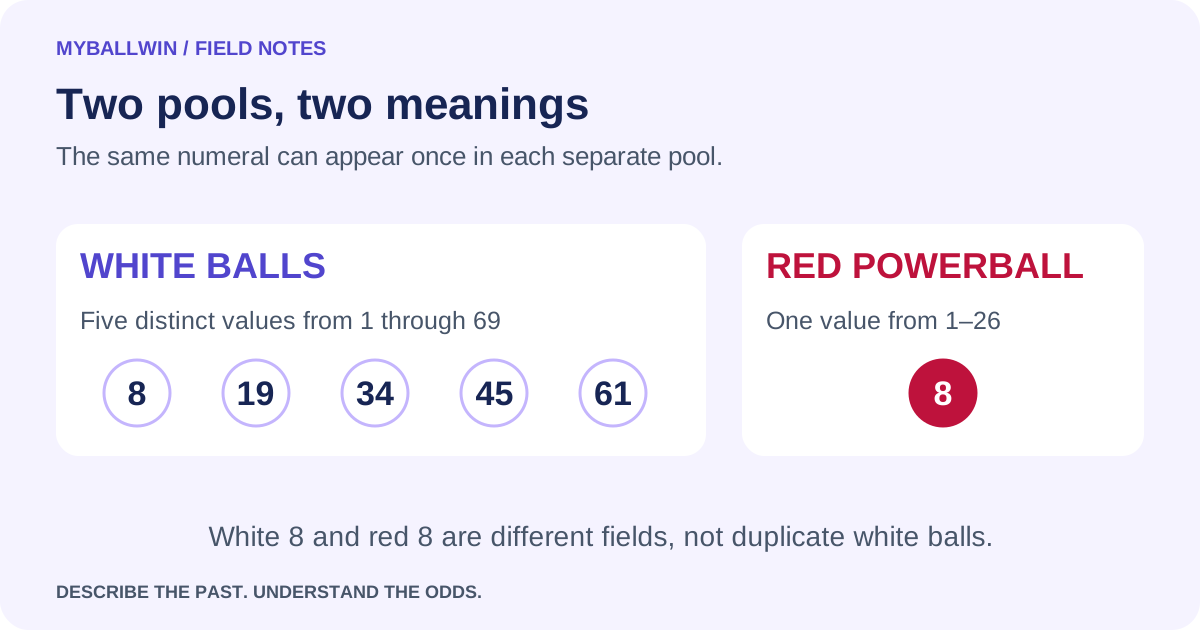
A repeated numeral can be valid
An illustrative line containing white balls 8, 19, 34, 45, 61 and red Powerball 8 is valid under these number ranges. The two eights come from separate pools. By contrast, placing two eights among the five white balls is invalid because those five values must be distinct. A validation routine needs to distinguish these cases rather than rejecting every repeated numeral across the whole line.
This distinction also matters when checking a result. Matching a red 8 requires an 8 in your red-Powerball field. Having an 8 among your white balls does not satisfy that condition. Display color helps convey the distinction, but labels such as white balls and Powerball are still necessary for readers who cannot reliably distinguish colors.
The appearance probabilities differ
One specified white number can occupy any of five selections, so its chance to appear in a fair drawing is 5/69, approximately 7.25%. One specified red number has probability 1/26, approximately 3.85%. Comparing their raw historical counts without acknowledging these different baselines can make a normal difference look like an anomaly.
Across N verified draws, total white-ball counts should sum to 5N and total red-ball counts should sum to N. If you normalize each pool to its total ball entries, both resulting distributions sum to 100%, but they still describe separate pools. Always label which denominator and pool a percentage uses.
Distinguish a match from a prize category
The chance of matching the red Powerball, regardless of white-ball matches, is 1/26. A prize tier described as matching only the red ball also requires zero white-ball matches. That additional restriction makes the tier probability different. The official prize chart lists mutually exclusive match categories, while a simple red-match statement can include several of those categories.
When building a spreadsheet or reviewing an analyzer, store the five white values and the red value in different columns. Keep any multiplier in another column again. This structure prevents range checks, sums, and pair counts from silently mixing incompatible fields. Separate pools are the foundation for accurate result checking and for statistical summaries that readers can interpret without guessing.
Official sources
Game rules and archive references checked October 3, 2026. Calculations and examples are MyBallWin explanations based on the stated assumptions.